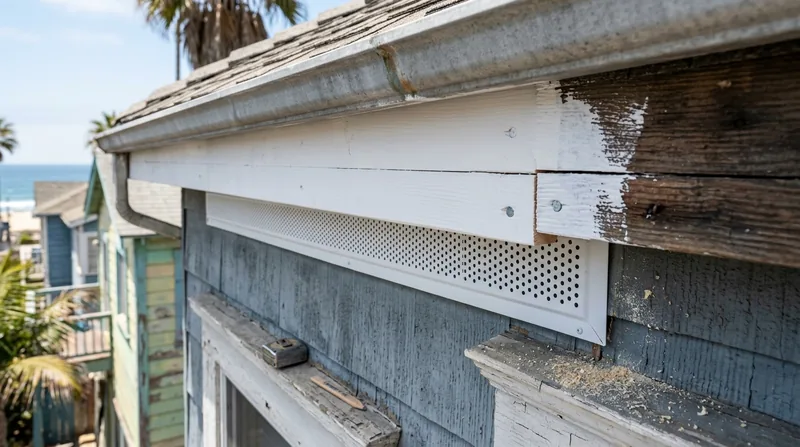




Fascia, Soffit & Exterior Trim Repair in Los Angeles stops moisture and termites at the roofline before they reach the structural framing underneath. Peeling paint and soft fascia boards are the first sign of termite entry or moisture moving in behind cracked stucco. Los Angeles' Mediterranean climate, year-round termite pressure, and the mix of older Spanish Colonial, Craftsman, and mid-century homes across Hancock Park, West Hollywood, Silver Lake, and the San Fernando Valley make this repair urgent and routine. We replace fascia, soffits, and exterior trim with primed, rot-resistant material, closing the gaps that let pests and moisture into the roofline. The work is straightforward, the payoff is real, and catching it early saves thousands in structural repair later.
Why Fascia and Soffit Failure Happens Fast in Los Angeles
Los Angeles' drywood termite season runs nearly year-round, and the mild winters mean moisture trapped behind failing stucco or under a damaged roofline never fully dries out. Fascia boards and soffits take the first hit. They sit at the eave, exposed to sun, rain, and the entry points termites and carpenter ants exploit. Once paint cracks or wood softens, water moves into the framing above, and termites follow. The cost of replacing a few linear feet of fascia is a fraction of what it takes to sister floor joists or replace a header.
- Termites enter through soft fascia and work upward into rafter tails and blocking.
- Moisture trapped behind stucco cracks accelerates wood rot in soffits and trim.
- Peeling or blistered paint signals that water is already moving into the wood.
- Replacing fascia and soffit closes the entry point and protects the structural framing above.
Early replacement of failed fascia and soffit is the most cost-effective termite and moisture defense a homeowner can make.
Key info: In neighborhoods like Los Feliz, Highland Park, and Hancock Park, where Craftsman and Spanish Colonial homes have deep eaves and exposed rafter tails, fascia failure is common. The wood is older, the eaves are larger, and termite pressure is relentless. Addressing it now prevents structural damage that costs ten times more to fix.
For guidance on what your local building department requires for exterior trim work, check the Los Angeles Department of Building and Safety website for permit thresholds in your area.
How We Replace Fascia, Soffit & Exterior Trim in Los Angeles Homes
We remove the failed fascia and soffit boards, inspect the framing behind them for termite or moisture damage, and replace with primed lumber or fiber-cement trim that resists rot and termite entry. The work happens from a ladder or scaffolding, and we seal all joints and fasteners so water cannot migrate back into the structure. If the framing behind the fascia shows damage, we address that separately, often as part of termite damage repair or wood rot repair.
- We remove the old fascia and soffit boards and inspect the rafter tails and blocking for damage.
- We measure and cut new primed lumber or rot-resistant trim to exact dimensions.
- We install the new fascia and soffit with corrosion-resistant fasteners and a sealed joint.
- We prime all cut edges and joints to prevent water entry and termite access.
- We inspect the gutter attachment points and ensure proper drainage away from the wall.
The job typically takes one to three days depending on the linear footage and whether the framing behind requires repair.
Example: A 1920s Craftsman bungalow in Los Feliz had 80 linear feet of soft fascia and rotted soffit blocking. We removed the old boards, found termite damage in two rafter tails, sistered those tails with new Douglas fir, and installed new primed fascia and fiber-cement soffit. The homeowner caught it at the paint-bubble stage, so the structural repair was minimal. Cost was well under $3,500.
Methods and Materials for Fascia, Soffit & Exterior Trim Repair
| Material or Method | Description | Best for |
|---|---|---|
| Primed Douglas Fir | Traditional softwood fascia and soffit, locally sourced, takes paint well, affordable. | Homes where wood appearance and traditional character matter, and repainting is planned every 5-7 years. |
| Fiber-Cement Trim | Engineered composite, termite-proof, rot-proof, primed, minimal maintenance, slightly higher upfront cost. | Homes where durability and low maintenance are priorities, especially in high-termite or high-moisture zones. |
| Redwood or Cedar | Natural rot resistance, warm color, primes and paints well, more expensive, still requires maintenance. | Homes where natural wood character is important and the homeowner commits to regular maintenance. |
| Aluminum or Vinyl Wrap | Metal or polymer cladding over wood fascia, eliminates painting, protects from weather and insects. | Homeowners seeking zero-maintenance finish, or where the underlying wood is sound but cosmetics need refresh. |
We recommend primed lumber or fiber-cement for most Los Angeles homes. Both resist termite entry, take paint well, and are cost-effective. The choice depends on your maintenance preference and how long you plan to stay in the home.
Fascia, Soffit & Exterior Trim Repair Cost in Los Angeles: What to Expect
Fascia and soffit replacement starts at around $700 for a small section or repair, and typically ranges from $1,500 to $4,000 for a full house depending on linear footage, material choice, and whether framing repair is needed. A 1,500-square-foot home with 120 linear feet of fascia and soffit usually falls in the $2,000 to $3,500 range if the framing is sound. If termites or rot have damaged the rafter tails or blocking, add $500 to $1,500 for sistering or framing repair. See our pricing page for more detail.
The main factors that move the cost are:
- Linear footage of fascia and soffit to be replaced.
- Material choice: Douglas fir is the baseline, fiber-cement or redwood costs more.
- Condition of the framing behind the fascia (sound wood or damage requiring repair).
- Access: steep roofs or complex eave geometry may require scaffolding or special equipment.
- Gutter condition and whether it needs repair or reinstallation after the new fascia.
Get two or three estimates. A contractor should visit the site, measure the linear footage, inspect the framing, and give you a written price before work begins. Estimates are free and should include material type, labor, and any framing repair discovered on-site.
Fascia, Soffit & Exterior Trim Repair Near Me: What Los Angeles Homeowners Should Know When Hiring
Fascia and soffit work is straightforward, but the contractor you hire should be comfortable working at height, understand termite entry points, and know how to seal joints properly so water cannot re-enter the structure. Check that the contractor is fully insured and carries liability coverage. Ask for references from recent fascia or soffit jobs in your neighborhood. If your home is in a historic district or has HOA restrictions, confirm that your contractor understands any exterior finish rules before ordering materials.
- Verify the contractor is fully insured with current liability and workers compensation coverage.
- Request references from three recent fascia or soffit jobs and call them.
- Ask whether the contractor primes all cut edges and seals all joints to prevent water entry.
- Confirm the contractor will inspect the framing behind the fascia and report any damage found.
- Check whether your HOA or historic district has exterior finish requirements and confirm the contractor knows them.
- Get the estimate in writing with material type, linear footage, labor, and any framing repair itemized separately.
If you are in Burbank, Pasadena, West Hollywood, or another area with strict historic preservation rules, make sure your contractor is comfortable with those requirements before you book. Contact us at our contact page with photos and a description of the work, and we will provide a free estimate within 24 hours.
Fascia, Soffit & Exterior Trim Repair in Los Angeles: Pricing Guide
| Service | Price | Details |
|---|---|---|
| Small fascia or soffit section | Starting at $700 | Up to 30 linear feet of fascia or soffit, primed lumber, no framing repair needed |
| Full house fascia and soffit replacement | Starting at $1,500 | 60 to 120 linear feet, primed lumber, sound framing, typical Los Angeles single-family home |
| Fascia, soffit, and framing repair | Starting at $2,500 | Includes sistering damaged rafter tails or blocking, new fascia and soffit, sealing all joints and fasteners |
| Fiber-cement or redwood upgrade | Add $300-$800 | Material upgrade from primed Douglas fir, depends on linear footage and species selected |
| Travel and estimate | Free and included | No travel charge within Los Angeles and service areas, free written estimate within 24 hours |
Indicative pricing, the exact cost depends on square footage, finish, and site access. Free personalized estimate within 24h at (213) 652-2684.


