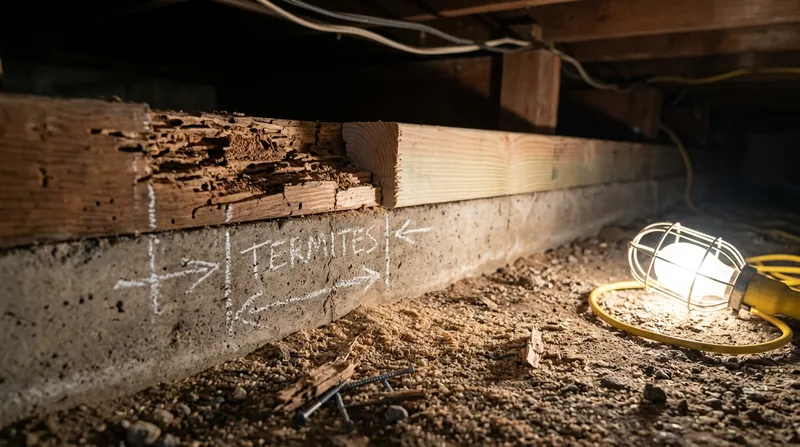




Termite Damage Repair in Los Angeles is a year-round necessity in one of the country's most termite-pressured residential markets. Los Angeles's mild, frost-free climate means drywood termite colonies never die back over winter, feeding continuously through the wood framing of Spanish Colonial Revival mansions in Hancock Park, Tudor homes in Windsor Square, Craftsman bungalows across Los Feliz and Highland Park, mid-century modern hillside homes above Silver Lake, and stucco-over-wood-frame subdivisions throughout the San Fernando Valley. After a pest inspection report comes back positive, the exterminator eliminates the live colony, but the damaged wood remains. We replace termite-eaten studs, sill plates, rim joists, floor joists, subfloor sections, and trim across Los Angeles homes, restoring full structural integrity and preventing further decay.
Why Termite Damage Repair Matters in Los Angeles: A Year-Round Threat
Los Angeles's Mediterranean climate, with dry warm summers and mild wet winters, creates ideal conditions for drywood termites to thrive. Unlike regions where termite activity slows or stops in winter, Los Angeles termite colonies remain active and destructive every month of the year. A single infestation can compromise floor joists, subfloor sheathing, wall studs, and exterior trim if left unaddressed. The damage spreads silently inside walls and under floors, weakening the structural frame and creating safety risks over time.
- Termites consume cellulose in wood, hollowing out joists and studs from the inside while the surface may appear intact.
- Damaged floor joists sag and bounce, creating uneven floors and stress on adjacent framing members.
- Compromised sill plates and rim joists allow moisture to penetrate deeper into the foundation interface and adjacent wood.
- Untreated termite damage compounds over seasons, multiplying repair costs and scope as decay spreads to neighboring wood members.
Addressing termite damage promptly restores the home's structural soundness and prevents the pathology from spreading to adjacent framing.
Key info: Los Angeles County has one of the highest termite pressure indices in the United States. Homes in neighborhoods from Santa Monica to Pasadena, Culver City to Burbank, and throughout the Valley face continuous risk. Your pest inspection report is the blueprint for repair work. We work directly from that report to replace only the wood that termites have damaged, restoring your home's integrity without over-specification.
For more information on termite and wood-decay pathologies, see the California Department of Food and Agriculture pest information.
How We Repair Termite Damage in Los Angeles: From Inspection to Restoration
Our process begins with your pest inspection report, which identifies the extent and location of termite damage. We assess the structural condition of each affected member, determine whether repair or replacement is the honest answer, and execute the work with precision. We replace damaged studs, joists, sill plates, and subfloor sections, sistering new framing where the old wood can be reinforced, and removing and replacing sections where the damage is too extensive. Every repair restores the original load-bearing capacity and protects against future moisture intrusion.
- We obtain a copy of your pest inspection report and walk the affected areas to confirm damage location and severity.
- We remove termite-damaged wood members, taking care to support the structure above until new framing is installed.
- We install new pressure-treated or solid-wood framing, sistering joists or studs where reinforcement is sufficient, and full replacement where damage is deep.
- We seal all exposed wood and gaps to prevent future moisture and pest entry, restoring the envelope integrity.
- We verify plumb, level, and load-bearing alignment before closing walls or subfloors.
The result is a home with restored structural integrity and confidence that the damage is fully addressed.
Local example: A Craftsman bungalow in Highland Park showed termite damage in the floor joists under the kitchen. Rather than replacing all joists, we sistered new pressure-treated 2x10 joists alongside the damaged ones, distributing the load and restoring bounce-free flooring. The homeowner avoided a full subfloor replacement and got a solid, long-lasting repair. Similar work in West Adams Victorian homes and Santa Monica beach bungalows has kept repair costs realistic while preserving structural integrity.
For related structural carpentry and joist repair work, see our floor joist and subfloor repair service.
Repair Methods and Approaches
| Approach | Description | Best for |
|---|---|---|
| Sistering | Install a new framing member alongside the damaged one, bolting or nailing them together to share the load. | Floor joists, wall studs, and rim joists with partial damage where the core wood is still sound. |
| Section Replacement | Remove the damaged section of a joist or stud and install a new pressure-treated splice, bolted and nailed for full load transfer. | Localized damage in the middle of a joist or stud where the ends are sound and can anchor the splice. |
| Full Member Replacement | Remove the entire damaged framing member and install a new one, supporting the structure above during removal. | Sill plates, rim joists, and primary load-bearing members where damage is extensive or concentrated near support points. |
| Subfloor Patching | Cut out termite-damaged subfloor sheathing and install new pressure-treated plywood or OSB, nailed to intact joists. | Localized subfloor damage in kitchens, bathrooms, and living areas where the joists below are still sound. |
| Trim and Casing Replacement | Remove termite-damaged interior or exterior trim, casing, or baseboard and install new solid wood or pressure-treated replacements. | Window and door casings, baseboards, and exterior trim where damage is surface or near-surface and does not affect structural framing. |
Termite Damage Repair Cost in Los Angeles: What to Expect
Termite damage repair in Los Angeles typically starts at $1,200 to $2,500 for localized damage to a few floor joists or trim sections, and scales upward based on the extent of damage, the number of affected members, and access difficulty. A full sill plate replacement, subfloor patching across a large area, or multiple load-bearing studs will run higher. The main factors that affect cost are the square footage of damage, the depth of infestation, whether joists or studs are accessible, and whether structural members like beams or rim joists are involved.
- Localized joist or stud repair using sistering typically costs less than full member replacement.
- Sill plate replacement and subfloor patching in crawl spaces or basements may require temporary support and careful sequencing, raising cost.
- Extensive damage across multiple rooms or floors, or damage near the foundation interface, requires more labor and materials.
- Access constraints, such as tight crawl spaces or homes in hillside neighborhoods with limited maneuvering room, can increase complexity and time.
The best approach is to get a free, no-obligation estimate from a carpenter who can inspect the damage in person and explain which repair method makes sense for your home and budget. See our full pricing overview for more detail on cost drivers and typical ranges across Los Angeles.
Termite Damage Repair Near Me: What to Look for When Hiring a Carpenter in Los Angeles
Choosing the right carpenter for termite damage repair means finding someone with experience in structural carpentry, a clear understanding of load-bearing members, and the honesty to explain repair options rather than oversell replacement. Ask for references from recent termite damage jobs, confirm that the carpenter is fully insured, and verify that they understand your local building department's requirements if any structural framing is involved. Get two or three estimates, and make sure each one explains the method (sistering, splicing, or replacement) and why it makes sense for your specific damage pattern.
- Confirm that the carpenter is fully insured and can provide proof of coverage before work begins.
- Ask for references from homeowners in Los Angeles, Beverly Hills, Pasadena, or your neighborhood who had similar termite damage work done.
- Verify that the carpenter understands whether your work requires a permit from your local building department, and is willing to pull one if needed.
- Request a detailed estimate that breaks down labor, materials, and method, so you understand what you are paying for.
- Check that the carpenter can access your crawl space, basement, or walls safely and will protect your home during the repair.
A good carpenter will walk you through the damage, explain what termites did and why the repair method works, and give you a realistic timeline and cost before any work starts. Contact us for a free estimate and let us show you the difference that clear communication and honest craftsmanship make in termite damage repair.
Termite Damage Repair in Los Angeles: Pricing Guide
| Service | Price | Details |
|---|---|---|
| Localized joist or stud repair | Starting at $1,200 | Sistering or splicing one to three damaged floor joists or wall studs, including material, labor, and support setup |
| Subfloor patching | Starting at $1,500 | Cutting out and replacing termite-damaged subfloor sheathing in kitchens, bathrooms, or localized areas up to 100 square feet |
| Sill plate or rim joist replacement | Starting at $2,500 | Full removal and replacement of a damaged sill plate or rim joist, including temporary support and foundation interface sealing |
| Extensive multi-area damage | On estimate | Damage across multiple rooms, multiple joists and studs, or foundation-adjacent areas requires on-site inspection and detailed scope |
| Travel and estimate | Free | No mileage fee or call-out charge in Los Angeles and surrounding service areas; response within 24 hours at (213) 652-2684 |
Indicative pricing, the exact cost depends on square footage, finish, and site access. Free personalized estimate within 24h at (213) 652-2684.


